

The global tungsten market has experienced significant disruption over the last 18 months. Supply constraints, export controls, and increasing demand have pushed tungsten prices higher, creating challenges for manufacturers that rely on tungsten-filled materials in critical medical device applications.
For medical device manufacturers, these challenges extend beyond procurement costs. Tungsten plays a critical role in many radiopaque compounds used in catheters, delivery systems, marker bands, and extruded tubing. When availability becomes constrained, production schedules, product costs, and material qualification efforts can all be affected.
Why Tungsten Matters in Medical Device Manufacturing
Radiopacity is essential for many minimally invasive medical devices. Physicians rely on fluoroscopy and X-ray imaging to visualize devices during procedures, making radiopaque materials a critical component of device performance.
Tungsten-filled thermoplastics are commonly used because they provide excellent visibility while maintaining the processing characteristics required for precision extrusion. As demand for minimally invasive devices continues to grow, manufacturers increasingly depend on radiopaque compounds to support catheter-based procedures and image-guided interventions.
When tungsten pricing rises or supply becomes limited, the impact can be felt throughout the product development and manufacturing process.
How the Tungsten Supply Chain Is Affecting Medical Device Production
The recent tungsten shortage is the result of several converging factors. China remains the dominant source of global tungsten production and has implemented export restrictions that have tightened supply availability. At the same time, growing demand across defense, aerospace, semiconductor, and industrial markets has increased competition for available material. As a dual-use material (used in military as well as medical device manufacturing) Tungsten exports from China have been restricted.
For medical device manufacturers, the consequences often include:
- Rising raw material costs
- Longer procurement lead times
- Increased supplier risk
- Pressure to evaluate alternate material sources
- Potential production delays
These challenges can become particularly acute for products that depend on radiopaque tubing or tungsten-filled compounds where material substitutions must be carefully evaluated to maintain performance and compliance requirements.
A Real-World Example: Solving a Tungsten Sourcing Challenge
Recently, one manufacturer producing radiopaque thermoplastic compounds for extruded medical tubing encountered difficulties securing tungsten material due to ongoing supply constraints.
The concern was straightforward: limited availability and rising costs threatened both production schedules and project budgets.
MET’s technical team worked with the customer to evaluate alternative tungsten options and identify a replacement grade that maintained the same CAS number as the original specification. After reviewing the material’s characteristics and application requirements, the team sourced an alternate solution from a qualified supplier.
The result was a successful transition that helped the customer:
- Maintain production timelines
- Reduce cost impact
- Preserve material consistency
- Maintain regulatory compliance requirements
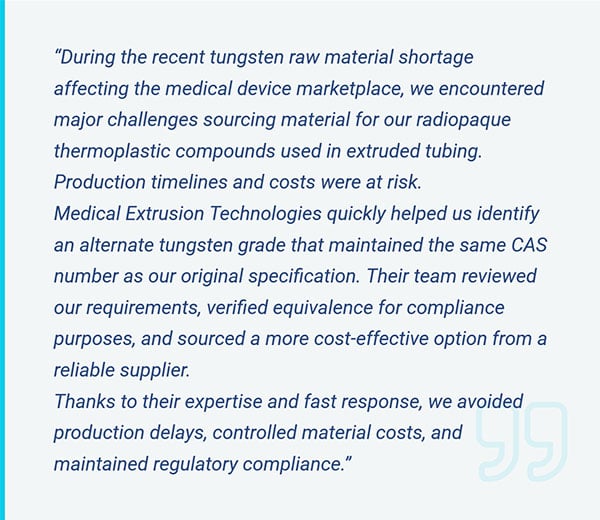
One customer described the experience this way:

Evaluating Alternative Materials Without Compromising Compliance
When material shortages occur, changing suppliers is rarely as simple as selecting the next available option.
Medical device manufacturers must consider:
- Material equivalency
- Regulatory requirements
- Material traceability
- Supplier qualifications
- Performance validation
- Process compatibility
Even when an alternate material appears similar on paper, technical review is often required to confirm suitability for the intended application.
Organizations that proactively evaluate supply chain risks and establish qualified alternatives are often better positioned to respond when disruptions occur.
Building Greater Supply Chain Resilience
While no manufacturer can eliminate market volatility, several strategies can help reduce risk.
Diversify Material Sources
Working with multiple qualified suppliers can improve flexibility when shortages arise.
Engage Material Experts Early
Technical consultation during sourcing discussions can help identify alternatives before production schedules are affected.
Monitor Market Conditions
Understanding broader tungsten pricing and supply trends allows procurement teams to plan more effectively.
Partner With Experienced Extrusion Specialists
Manufacturers with extensive experience in radiopaque materials, compound selection, and medical extrusion can help identify solutions that balance performance, compliance, and supply chain considerations.
Read More: Onshoring: A Strategic Lever To Pull For Medtech Manufacturing Companies
Navigating the Future of Tungsten Supply
Industry analysts continue to forecast elevated tungsten prices and ongoing supply pressures as global demand remains strong and alternative production sources take time to develop.
For medical device manufacturers, success will increasingly depend on proactive sourcing strategies, strong supplier relationships, and technical expertise that enables rapid response when market conditions change.
As material markets evolve, companies that combine procurement planning with engineering support will be best positioned to maintain production continuity while continuing to deliver high-quality medical devices to the market.
Need Help Navigating Material Supply Challenges?
Whether you’re evaluating radiopaque compounds, sourcing alternative tungsten materials, or developing a new catheter or tubing application, MET’s team can help identify solutions that balance performance, compliance, and supply chain stability.
Contact us to start your project
More information